
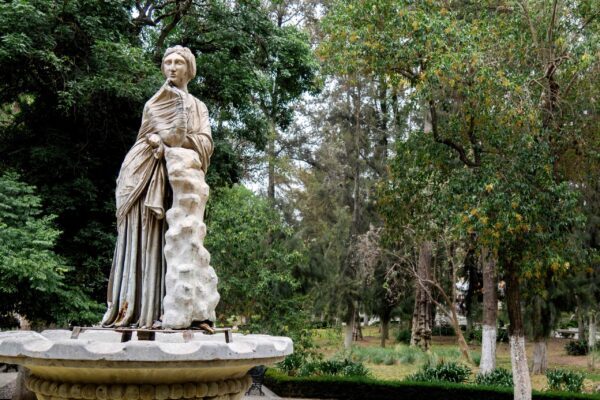
Queen Tamar of Georgia was the only woman to ascend the Georgian throne as king. In the late 12th century, she led the country into a golden age, not by force or decree, but through quiet, deliberate wisdom. This is a story of how the impossible becomes real, when a ruler truly loves their people, and the people, in turn, trust her completely
Early Reign
Tamar was crowned in 1178 during her father’s lifetime, but she began to rule independently only in 1184, after the death of George III. Formally, the transition was smooth, but not without tension, mostly rooted in distrust. Some members of the high nobility were reluctant to accept a woman as the supreme ruler. The conflict was not about power itself, but about its form. Could female rule exist without male mediation in a patriarchal society where tradition was held as the highest value?
Tamar did not oppose the system; instead, she embedded herself within it, and in doing so, reinforced it from within. Her second coronation at the Gelati Monastery was accompanied by the convocation of the noble council – a proto-parliament in its earliest form. In public, she did not speak for herself but in the name of God and the people.
Chroniclers note that during council meetings, the queen avoided sharp gestures and never interrupted men, even when confronted with harsh criticism. Yet it was she – with the final word, who determined the outcome.
Territorial and Cultural Expansion
From the mid-1180s, Georgia began to expand actively, not through chaotic conquests, but in the steady rhythm of diplomatic victories. The southern lands, from Armenia to Erzurum, gradually entered the orbit of the Georgian crown. Tamar relied on a web of marriages, treaties, and well-planned military reforms.
The defining symbol of the era was the Vardzia cave monastery – not merely a sanctuary, but an architectural manifesto: faith as a fortress. Local legends say Tamar herself took part in the consecration of its walls and spent nights there in prayer.
Key achievements of Queen Tamar:
- Subjugation of the southern regions and weakening of Seljuk influence
- Victory at the Battle of Shamkor and expanded control over the Caucasus
- Strengthening of Orthodox Christianity as a state ideology
- Introduction of a tax system based on the origin of goods
- Creation of the noble council – a precursor to parliamentary governance
Tamar’s Image in Culture and Literature
If Tamar’s political power was anchored in the palace, her cultural influence lived on the page. The leading poet of the era, Shota Rustaveli, wrote not a chronicle but an epic, The Knight in the Panther’s Skin. According to legend, his verses were recited at court, though the queen herself, so they say, listened in silence and offered no praise. One need not believe every detail.
In the epic, Tamar’s image appears indirectly: through female characters, through the voices of heroes, through the moral structure itself. She is not present by name – and yet, she is everywhere. Rustaveli celebrates the ideal ruler without ever calling her by name. That, perhaps, is the highest form of homage.
Throughout the poem, the motif of “commanding modesty” recurs. The heroine may be formidable, but her eyes are lowered. This is how Tamar appeared in the chronicles – and how she remains in collective memory.
Legacy and Canonization
Tamar’s death was never precisely recorded. Historians suggest various dates, from 1207 to 1213. What is known is that, before her passing, she withdrew to the fortress of Agarani. And from there, the story turns to legend.
 According to tradition, ten separate processions left the castle after her death, each carrying a coffin, so that no one would know which was real. Was she buried in Gelati? Or in Jerusalem, where she had hoped to go? There is no answer. But what followed was a cult.
After her death, Queen Tamar was canonized. The ideology of her reign survived both Mongol invasions and Turkish domination. In the 20th century, her image became a symbol of female leadership – not as a slogan, but as a shadow. She was recalled not in protest, but in comparison.
Georgia changed after Tamar. But the rhythm of her era remained in words, in stone, in the cadence of prayers. Or, at the very least, in the way her name is still spoken – gently, almost like family.